Keep your existing PBX
signal2sip doesn’t replace any part of your telephony setup - it registers against your existing Asterisk, FreePBX, or any other SIP-compatible PBX as an ordinary SIP endpoint, the same way a desk phone or softphone would.
How it connects
Each Signal account signal2sip manages gets its own dedicated SIP transport and registration, configured per account:
sip_host/sip_extension/sip_password- a normal SIP registration against your PBX.sip_transport=udporsip_transport=tls(SIPS) - plain UDP or a TLS-secured signaling transport, your choice per account.sip_srtp=disabled|optional|mandatory- whether the RTP media itself is secured (SDES-SRTP) on top of the signaling transport.
Nothing on the PBX side needs to know signal2sip isn’t a regular phone - your existing dialplan, inbound routes, and extension numbering all keep working unchanged.
Both directions
- Signal call in, bridged to the PBX:
sip_bridge_destination(a plain extension) orsip_bridge_did(an Inbound-Route-style DID, letting FreePBX’s own routing/IVR/ring-group logic decide the real destination) - see Two-way reachability. - PBX call out, bridged to Signal: dial through signal2sip’s extension and it places a real outgoing Signal call, resolving the dialed number via Signal’s own Contact Discovery.
Codec: your PBX endpoint must allow L16/48000 (slin48)
m=audio 0,
PBX responds 488 Not Acceptable Here).signal2sip’s internal audio bridge moves raw, uncompressed audio between RingRTC and PJSIP with no transcoding step at all - by design, to avoid the CPU cost and quality loss of encoding/decoding on every packet. That only works if PJSIP negotiates the exact format the bridge already uses internally, so the daemon deliberately offers a single codec on every SIP call: L16/48000/1 (16-bit linear PCM, 48kHz, mono) - every other codec PJSIP knows about (G.711, G.722, Opus, GSM, …) is explicitly disabled, not just deprioritized.
What this means for your PBX config: the endpoint/trunk signal2sip
registers against must have this codec allowed, or the call never gets
media at all. In Asterisk/FreePBX (chan_pjsip), this codec is called
slin48 - make sure it’s in the endpoint’s allowed codec list, e.g.:
[signal2sip-trunk]
allow=!all,slin48
If a call’s SIP signaling looks fine (registration succeeds, INVITE
goes out) but audio never comes up and the PBX rejects with 488,
this codec mismatch is the first thing to check.
Caller ID on your phones
When a Signal call comes in and gets bridged out to the PBX, signal2sip attaches the caller’s real Signal identity to the outgoing INVITE as custom SIP headers:
X-Signal-UUID- always present, the caller’s Signal account identifier.X-Signal-Phone/X-Signal-Name- best-effort, populated when that contact’s phone number/display name is already known locally (synced from Signal’s contact sync) - not guaranteed for every caller.
FreePBX/Asterisk don’t read custom SIP headers by default, so your
dialplan needs an explicit step to pick them up and map them onto real
Caller ID. A minimal FreePBX example, in a custom context read via
PJSIP_HEADER:
[from-signal2sip-headers]
exten => _X.,1,Set(CALLERID(name)=${IF($["${PJSIP_HEADER(read,X-Signal-Name)}"!=""]?${PJSIP_HEADER(read,X-Signal-Name)}:Signal#${PJSIP_HEADER(read,X-Signal-UUID)})})
 same => n,Set(CALLERID(num)=${IF($["${PJSIP_HEADER(read,X-Signal-Phone)}"!=""]?${PJSIP_HEADER(read,X-Signal-Phone)}:${PJSIP_HEADER(read,X-Signal-UUID)})})
 same => n,Dial(PJSIP/${EXTEN},30)
Point the relevant Inbound Route (the specific DID, not a catch-all - catch-all routes are evaluated last and would never see this) at that context instead of dialing straight through. Once wired up, a bridged Signal call shows the real caller’s name/number on your desk phones, the same as any other trunk.
Step-by-step: doing this entirely from the FreePBX web UI
If you’ve never hand-edited Asterisk dialplan before, the minimal example above can be confusing to actually wire up - here’s the same result done end to end through the web UI, with a slightly more defensive version of the dialplan that holds up better in practice than the minimal one.
Add the context
FreePBX’s own Config Edit module (Admin -> Config Edit) can add this
without ever opening an SSH terminal: pick extensions_custom.conf,
paste the block below, and save. It does the same thing as the minimal
example above, plus three real improvements worth having once you’re
pasting this into a production PBX anyway:
[from-signal2sip-headers]
exten => _.,1,NoOp(Incoming Signal call via signal2sip)
 same => n,Set(SIG_UUID=${PJSIP_HEADER(read,X-Signal-UUID)})
 same => n,Set(SIG_PHONE=${PJSIP_HEADER(read,X-Signal-Phone)})
 same => n,Set(SIG_NAME=${PJSIP_HEADER(read,X-Signal-Name)})
 same => n,Set(CALLERID(name)=${IF($["${SIG_NAME}"!=""]?${SIG_NAME}:Signal#${SIG_UUID})})
 same => n,Set(CALLERID(num)=${IF($["${SIG_PHONE}"!=""]?${SIG_PHONE}:${SIG_UUID})})
 same => n,Dial(PJSIP/106,30)
same => n,Hangup()_.instead of_X.- this context is entered via a Custom Destination (below), not a normal number match, so the extension pattern needs to accept whatever FreePBX hands it through, not just digits.- Each header read once, into
SIG_UUID/SIG_PHONE/SIG_NAME, instead of callingPJSIP_HEADER(read,...)inline insideIF(...)- Asterisk substitutes every${...}in a line before evaluatingIF(), so the inline version silently reads each header twice per line (once for the condition, once for the branch) regardless of which branch wins. Harmless here, but worth knowing before relying on that inline pattern elsewhere in your dialplan. - Replace
106with the real extension you want Signal calls to ring at your site. Unlike the minimal example, this doesn’t dial${EXTEN}dynamically - by the time execution reaches here,${EXTEN}is whatever the Custom Destination passed through, not necessarily a real PJSIP endpoint name. - The trailing
Hangup()makes call teardown explicit ifDial()returns without an answer (busy/no-answer/timeout), instead of relying on Asterisk’s own implicit end-of-dialplan handling.
Apply the config (the usual red bar) after saving.
Register it as a Custom Destination
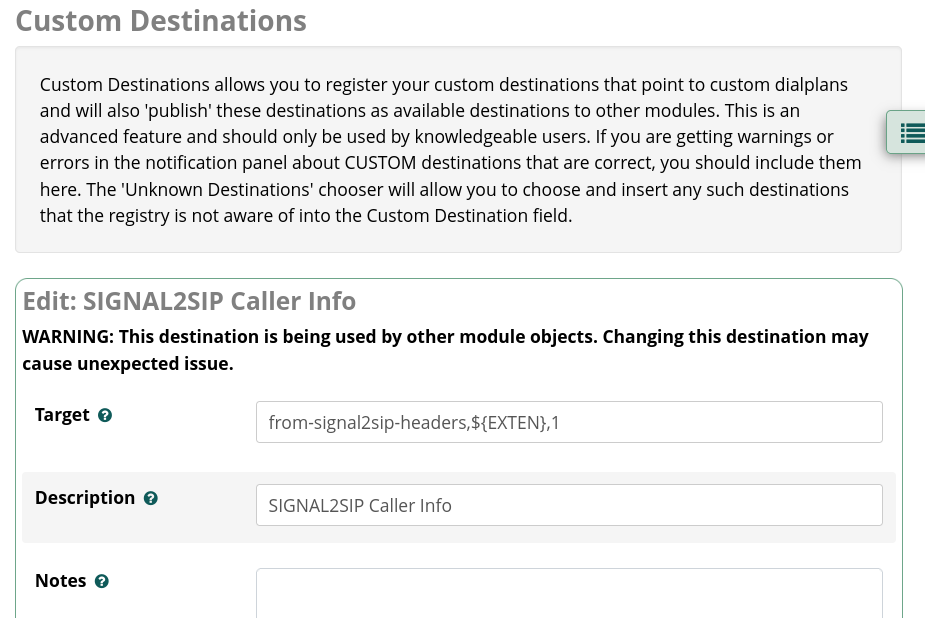
Admin -> Custom Destinations -> Add Destination. Set Target to
from-signal2sip-headers,${EXTEN},1 (the context you just added,
priority 1), and give it a description you’ll recognize later, e.g.
“SIGNAL2SIP Caller Info”:
Submit and apply config.
Point an Inbound Route at it
Connectivity -> Inbound Routes, open the specific DID signal2sip’s
sip_bridge_did sends calls to (not a catch-all - catch-all routes are
evaluated last and would never see this), and set its Destination to
the Custom Destination you just created, instead of dialing an extension
directly.
Live config, no restart
Every per-account setting lives in the daemon’s own database, not
a static config file - only a handful of process-wide settings (the
database path/key, watchdog/poll intervals) live in
/etc/signal2sip/signal2sip.conf’s single [global] section. Change an
account’s settings with signal2sip-gendb <name> config set <field> <value> or through the terminal UI, and the daemon picks the change up
live (SIGHUP or a periodic poll), no restart needed. See Manage it
live.
This per-account database row isn’t touched by a soft deactivate (a
reversible, server-side-only flag flip - all local data stays put,
reactivate undoes it) - only unlink (wipes this account’s local row,
leaves the real Signal account untouched) or a successful
delete-account (which also destroys the account on Signal’s own
servers) actually deletes it.